

Finasteride for hair loss is FDA-approved as an oral tablet for male pattern hair loss in men: it lowers DHT and can slow further loss, and some men also regrow hair.
Benefits require continued use, side effects deserve a discussion before treatment, and the approval does not extend to compounded topical finasteride.
This guide explains how oral finasteride works, who it fits, what results to expect, its side effects and safety questions and how follow-up works.
| Decision area | What the clinician reviews | Why it changes the discussion |
|---|---|---|
| Hair-loss pattern | Gradual temple, frontal or crown miniaturization | Other patterns may not be androgenetic alopecia |
| Sexual health | Desire, erections, ejaculation and baseline symptoms | Label and postmarketing effects overlap with common concerns |
| Reproductive goals | Fertility plans and prior semen concerns | Semen quality can be relevant in selected men |
| Mood history | Depression, anxiety and new mood symptoms | Changes should be reported and assessed |
| Breast or testicular symptoms | Tenderness, enlargement, lumps or pain | New findings require medical review |
| PSA monitoring | Baseline prostate context and finasteride exposure | The medicine can lower measured PSA |
In this article
How Long Does Finasteride Take to Work?
Finasteride works slowly. The label notes that daily use for three months or more may be needed before any benefit is seen, and changes are usually judged over a year.
The first sign of success is often less shedding and a hairline that stops moving, rather than visible regrowth. Comparing photos taken months apart is the fairest way to judge it.
How oral finasteride works
What is finasteride?
Finasteride is a prescription 5-alpha-reductase inhibitor. FDA-approved finasteride tablets carry separate labels for male pattern hair loss and for benign prostatic hyperplasia. Product and indication should never be blurred.
Oral finasteride’s hair-loss indication is male androgenetic alopecia. An independent Florida-licensed physician decides whether finasteride fits your diagnosis and health. A licensed pharmacy dispenses any prescription.

How does finasteride affect DHT?
The enzyme 5-alpha-reductase converts testosterone to dihydrotestosterone, or DHT. Finasteride inhibits the type II form of that enzyme. DHT concentrations fall, which reduces signaling in genetically susceptible scalp follicles.
Male pattern hair loss reflects inherited follicle sensitivity, not a high serum testosterone or DHT result. Routine hormone testing is not required for every recognizable pattern.
Lowering DHT does not create new follicles. The clinical aim is to slow ongoing miniaturization and, in some men, let affected follicles produce thicker hairs.
Who it fits and what results mean
Which pattern may fit the indication?
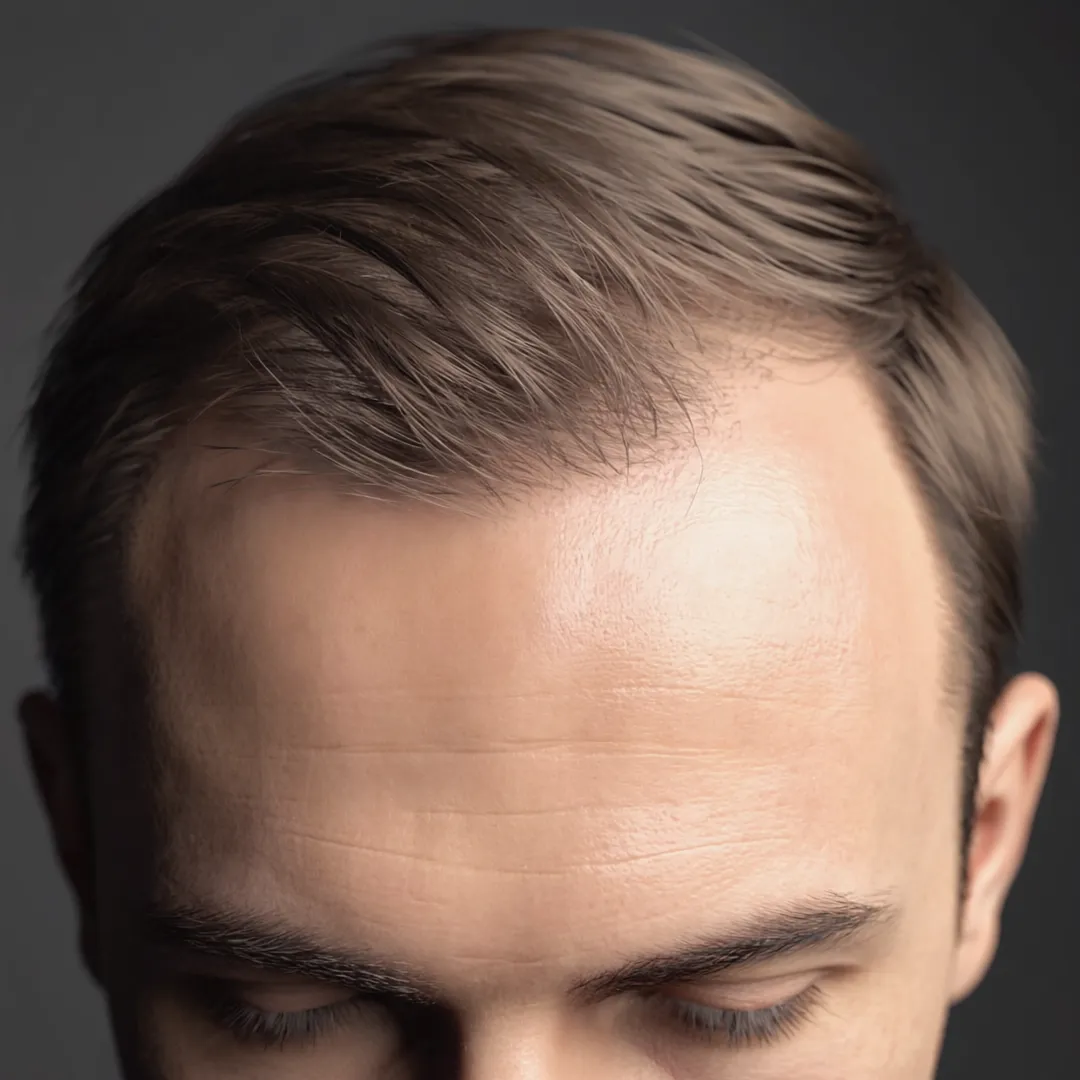
Androgenetic alopecia develops gradually, often with recession at the temples, thinning across the frontal or mid-scalp, and loss at the crown. Dermoscopy may show variation in hair-shaft diameter and miniaturization.
Sudden shedding after illness, smooth patches, broken hairs, marked scale, pustules, pain or loss of follicular openings point to another condition. Treating the wrong pattern delays care for telogen effluvium, infection, alopecia areata or scarring disease. The male hair-loss evaluation guide covers the diagnostic sequence.
Family history supports the pattern but does not decide it. Relatives may thin at different ages or in different areas, and susceptibility can come through either side of the family. Baseline photographs and a scalp examination are stronger evidence than assuming any shedding in a man is hereditary.
What can treatment realistically do?
Clinical trials and labeling support finasteride’s role in slowing progression and improving hair measures in some men with male pattern hair loss. Individual cosmetic response varies and cannot be promised.
Hair cycles are slow, so a fair assessment compares photographs across a longer interval rather than daily mirror checks. Lighting, hair length, styling and wetness change how density looks even when it is stable.
Longstanding smooth areas with extensive follicle loss set different expectations from recent miniaturization. No medicine restores a teenage hairline on demand.
What happens after treatment stops?
Finasteride does not remove inherited susceptibility. After treatment stops, DHT activity returns toward baseline and hair loss can progress.
Hair retained during treatment may be lost over time. That is not chemical dependence. The treatment effect simply no longer opposes the continuing process.
Anyone considering stopping because of an adverse effect should contact the prescriber. Clinical assessment matters more than preserving a cosmetic result.

Side effects and safety questions
Which sexual effects are discussed?
Finasteride labeling reports decreased libido, erectile dysfunction and ejaculation disorders among possible adverse effects. Many men do not experience them, but the possibility belongs in informed consent.
Baseline symptoms should be documented because reduced desire and erectile problems are common and have many causes. A symptom that began before treatment differs from a clear new change after starting.
Persistent symptoms after discontinuation have been reported. The clinician should evaluate duration, other causes, distress and next steps without dismissing the concern or promising a recovery timeline.
Precision helps. These are different outcomes with different competing causes:
- Reduced desire
- Difficulty with erections
- Reduced ejaculate volume
- Fertility concerns
Alcohol, diabetes, vascular disease, depression, relationship stress and other medicines can overlap, so timing and a baseline record sharpen the assessment.
How can fertility and semen quality be affected?
Postmarketing information includes male infertility or poor seminal quality, with improvement reported after discontinuation in some cases. The overall significance varies, so near-term fertility goals should be disclosed before prescribing.
A testosterone result does not measure fertility. Semen analysis addresses sperm concentration, movement and other parameters when clinically indicated.
Anyone already in a fertility evaluation should make sure the reproductive clinician knows about finasteride. No one should add or stop another hormone medicine without medical direction.
What mood symptoms should be reported?
Depression and suicidal ideation appear in postmarketing safety information. One symptom does not prove cause, but new or worsening depression, anxiety, marked mood change or suicidal thoughts need prompt attention.
Immediate danger or suicidal intent requires emergency or crisis support; in the United States, call or text 988. Routine hair-loss follow-up is not the right response to an acute mental-health emergency.
The prescriber reviews baseline mood history and current medicines. A cosmetic goal never outranks urgent mental-health care.
Why do breast and testicular symptoms matter?
Breast tenderness and enlargement have been reported. Lumps, nipple discharge or persistent change need clinical assessment rather than an assumption that the medicine explains everything.
Testicular pain also appears in postmarketing reports. Pain, swelling, a new mass or acute symptoms need evaluation for other causes.
Reporting a symptom does not prove causation. It gives the clinician what is needed to judge timing, severity and competing explanations.
How does finasteride affect PSA?
Finasteride can lower serum prostate-specific antigen. Any clinician interpreting PSA needs to know the product, duration and adherence, even when the medicine was prescribed for hair loss rather than prostate enlargement.
A lower PSA does not remove prostate-cancer risk. The responsible clinician accounts for treatment when comparing baseline, trend, symptoms and examination. The PSA monitoring guide explains why medicine context stays attached to the result.
Who should avoid it and how follow-up works
Who should not take finasteride?
Finasteride is not indicated for women or children. It is contraindicated in women who are or may become pregnant and in anyone with a prior hypersensitivity reaction to it.
The label warns that women who are or may become pregnant should not handle crushed or broken tablets, because absorbed finasteride can affect development of a male fetus. Intact tablets are coated, and handling should follow the label and pharmacist instructions.
An accidental exposure concern should go to a clinician or poison control. Liver disease and other medicines also belong in the prescribing review.
Does the approval cover topical finasteride?
No. FDA has not approved any topical finasteride product in the United States. A pharmacy-prepared topical does not inherit the oral tablet’s approval simply because it shares an ingredient.
FDA’s 2025 alert reported adverse events with compounded topical finasteride. It noted that skin absorption into the bloodstream is expected and that transfer to other people is possible. The topical finasteride status guide covers that boundary in full.
| Question | Oral finasteride tablet | Topical finasteride |
|---|---|---|
| FDA status | Approved for male pattern hair loss in men | No FDA-approved product in the United States |
| How it is made | Manufactured under an approved application | Prepared by a pharmacy |
| Reaches the bloodstream | Yes, by design | Yes; FDA says skin absorption is expected |
| Exposure risk to others | Crushed or broken tablets during pregnancy | Residue on skin, hair or shared surfaces |
Which changes belong in finasteride follow-up?
Baseline photographs, distribution, scalp findings, sexual and mood symptoms, fertility goals and relevant medicines form the starting record. Comparable photographs later show whether density and pattern changed.
Follow-up should ask about adverse effects directly. Embarrassment can hide sexual or mood symptoms unless the clinician opens the door.
PSA context, new breast or testicular findings and plans to conceive can change the decision even when hair looks stable. New prostate treatment, hormone use, psychiatric medicine or supplements can also alter symptoms or lab interpretation. Follow-up is a renewed check that the indication still fits and the treatment burden stays acceptable.
We think finasteride is underrated and oversold at the same time. It is one of the best-supported options for keeping hair, but it rewards patience and consistency, not quick checks in the mirror.
Common questions
Is finasteride FDA approved for male pattern hair loss?
Yes. A prescription finasteride tablet is FDA approved for male pattern hair loss in men under its specific label.
Does it lower testosterone?
It inhibits conversion of testosterone to DHT. Its hair-loss mechanism is not a treatment for low testosterone.
Are sexual adverse effects possible?
Yes. Decreased libido, erectile dysfunction and ejaculation disorders appear in labeling and should be discussed before treatment.

Atlas HRT Team
Reviewed by · Last reviewed September 2026Atlas HRT specializes in male pattern hair loss treatment with finasteride for men in Florida.
Sources
- Propecia (oral finasteride) prescribing information, Organon; accessed October 10, 2026
- FDA alert on compounded topical finasteride, April 22, 2025, U.S. Food and Drug Administration; accessed October 10, 2026
